
Hiring more engineers sounds straightforward until the real questions begin.
Should you spend months building an internal team, or bring in experienced developers who can join an existing project sooner? Who should own architecture? What happens when the workload drops? Do you need permanent employees or specialized expertise for a specific migration, integration, or product release?
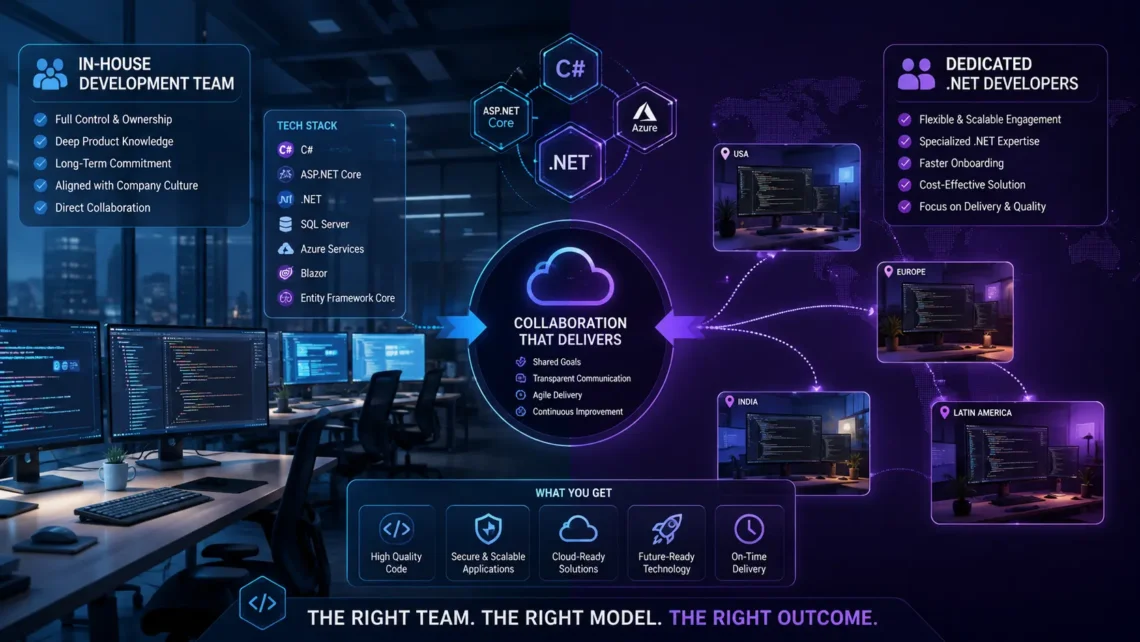
These questions make Dedicated Developers vs In-House Developers an important decision for CTOs, founders, engineering managers, and IT leaders running .NET projects.
The right answer is rarely that one model is universally better. An internal engineering team can provide deep organizational knowledge and long-term ownership. Dedicated .NET developers can provide specialized skills, additional capacity, and greater flexibility without requiring every capability to become a permanent internal role.
For modern .NET projects, that decision may involve C#, ASP.NET Core, Azure, Blazor, .NET MAUI, APIs, databases, security, cloud infrastructure, and legacy modernization. Microsoft currently lists .NET 10 as an active Long Term Support release through November 2028, making ongoing technical expertise and lifecycle planning relevant for companies maintaining modern .NET systems.
Quick Answer
Dedicated developers are usually better when a company needs specialized .NET expertise, faster team expansion, or flexible capacity without permanent hiring. In-house developers are often better when software is a long-term core capability requiring deep institutional knowledge and continuous ownership. Many organizations use a hybrid model: internal technical leadership supported by dedicated external .NET engineers.
Key Takeaways
- In-house teams offer strong organizational knowledge and long-term ownership.
- Dedicated developers can help businesses add specialized engineering capacity without building every capability internally.
- The correct choice depends on project duration, internal leadership, technical complexity, hiring capacity, and product strategy.
- Dedicated teams are particularly useful for bounded initiatives such as modernization, integrations, cloud migrations, or new product modules.
- In-house development can make more sense when engineering is central to the company’s permanent competitive advantage.
- A hybrid approach can provide internal control while giving the company access to additional .NET expertise when required.
What Are Dedicated .NET Developers?
Dedicated .NET developers are external engineers assigned to work consistently on a client’s product, project, or engineering backlog for an agreed period.
Unlike hiring a freelancer for a small isolated task, a dedicated developer generally becomes part of the delivery process and collaborates with the client’s product managers, architects, developers, QA engineers, and stakeholders.
Depending on the engagement, dedicated developers may work with technologies such as:
- C#
- ASP.NET Core
- Modern .NET
- Microsoft Azure
- Blazor
- .NET MAUI
- Entity Framework Core
- SQL Server
- REST APIs
- Microservices
- Containers
- Kubernetes
- CI/CD
- Authentication and authorization
- Legacy .NET applications
ASP.NET Core itself is Microsoft’s cross-platform, open-source framework for building modern web applications and services, including APIs, Blazor applications, SignalR, gRPC, authentication, authorization, configuration, and dependency injection.
A dedicated development arrangement can involve a single specialist or a larger team with backend developers, frontend engineers, QA, DevOps, and technical leadership.
What Are In-House Developers?
In-house developers are employees directly hired by the company and integrated into its permanent organizational structure.
They typically work continuously on company products, internal systems, technical operations, and future roadmap initiatives.
An in-house developer may accumulate significant knowledge about:
- Business processes
- Product history
- Customer requirements
- Internal systems
- Architecture decisions
- Company culture
- Operational constraints
- Long-term technical strategy
This accumulated context is one of the strongest arguments for building an internal engineering organization.
However, internal hiring also means the company takes responsibility for recruiting, onboarding, retention, management, career development, employee benefits, infrastructure, and maintaining appropriate utilization over time.

Dedicated Developers vs In-House Developers: Side-by-Side Comparison
| Factor | Dedicated Developers | In-House Developers |
| Hiring model | External dedicated engagement | Permanent employment |
| Best suited for | Scaling, specialist skills, defined initiatives | Long-term internal capability |
| Team expansion | Usually easier to adjust | Requires recruitment and onboarding |
| Organizational knowledge | Builds over engagement | Usually deeper over time |
| Specialist access | Easier to add for specific requirements | Requires hiring or training |
| Management | Shared or client-led | Fully internal |
| Architecture ownership | Client, provider, or shared | Usually internal |
| Capacity flexibility | Higher | Lower |
| Long-term continuity | Depends on engagement | Potentially stronger |
| Recruitment responsibility | Provider typically handles sourcing | Company handles internally |
| Best for temporary demand | Strong fit | Often inefficient |
| Best for permanent core capability | Useful as support | Strong fit |
Neither structure automatically produces better software.
A weak internal team can create technical debt, and a poorly selected external team can do the same. The quality of engineering leadership, architecture, QA, documentation, communication, and delivery discipline matters more than the employment model itself.
When Dedicated .NET Developers Make More Sense?
1. You Need to Expand Engineering Capacity Quickly
A product roadmap may suddenly require more backend work, integrations, APIs, or cloud engineering than the existing team can handle.
Permanent recruitment is not always the most practical response to a temporary capacity problem.
Dedicated developers can extend the existing team while internal leadership continues to control priorities and architecture.
DotNetDevelopers.us describes a similar model in its technical buyer guide: when a company already has product leadership, architectural direction, and established delivery rituals, embedded external .NET capacity can work effectively inside that environment.
2. You Need Specialized .NET Expertise
Your current developers may understand the product extremely well but have limited experience with a specific technical challenge.
Examples include:
- Migrating .NET Framework applications
- ASP.NET Core modernization
- Azure architecture
- Kubernetes deployment
- Blazor modernization
- .NET MAUI applications
- Performance troubleshooting
- Identity and security
- Complex third-party integrations
Hiring a permanent employee for every specialist skill may not be necessary.
3. You Have a Defined Modernization Initiative
Legacy modernization is often well suited to dedicated teams.
A company may have excellent internal developers who understand the existing platform but need engineers experienced with modern migration patterns.
DotNetDevelopers.us specifically notes that organizations short on internal .NET migration depth can use a dedicated squad for bounded migration areas while internal staff learn the new patterns.
4. Development Demand Changes Throughout the Year
Some organizations require eight developers during a major product release but only four afterward.
Maintaining permanent headcount based on peak workload can create unnecessary organizational overhead.
A dedicated model can make it easier to adjust engineering capacity around delivery requirements.
When In-House Developers Make More Sense
Dedicated development is not the right answer for every company.
1. Software Is Your Company’s Core Intellectual Capability
If technology itself is the foundation of your competitive advantage, maintaining strong internal engineering ownership can be valuable.
Internal engineers continuously accumulate knowledge about why systems work the way they do—not merely how they work.
2. You Need Long-Term Product Ownership
Products expected to evolve continuously over many years benefit from people who understand:
- Historical architecture decisions
- Customer feedback
- Business priorities
- Internal dependencies
- Operational realities
This knowledge becomes difficult to document completely.
3. Development Workload Is Consistently High
If you know you will require a particular engineering role for several years, direct employment may make strategic sense.
4. Your Organization Requires Maximum Internal Control
Some organizations prefer to retain development, security processes, infrastructure access, and technical decision-making entirely inside the company.
This can be particularly important when internal governance structures require strict control over engineering operations.
In-House Development vs Outsourcing: It Is Not Always Either/Or
The phrase in-house development vs outsourcing often suggests that a company has to choose one and reject the other.
In practice, many technology organizations benefit from combining both.
Consider this structure:
Internal team
- CTO
- Product owner
- Software architect
- Core senior developers
- Domain specialists
Dedicated external team
- Additional ASP.NET Core developers
- Azure specialist
- QA automation engineer
- DevOps engineer
- Migration specialist
The internal team maintains product direction and institutional knowledge while external engineers provide capacity and specialist expertise.
This model can be especially useful when internal leadership is strong but delivery capacity is limited.
Dedicated Developer vs Dedicated Squad
These models should not be confused.
A dedicated developer normally joins an existing engineering organization.
A dedicated squad can take responsibility for a more clearly defined outcome.
For example:
Dedicated Developer
Your internal team already manages:
- Backlog
- Sprint planning
- Architecture
- QA
- Releases
You simply need two additional senior ASP.NET Core engineers.
Dedicated Squad
You need a team to deliver:
- A migration wave
- New application module
- Integration program
- Azure modernization initiative
In that situation, the external team may carry more responsibility for planning, testing, coordination, and release execution.
DotNetDevelopers.us makes this distinction in its existing guide, noting that dedicated squads are better suited to bounded outcomes when the provider needs to carry more delivery coordination than embedded engineers alone.
Cost: Dedicated Developers vs In-House Developers
There is no universal answer to which model is cheaper.
The correct comparison is total cost, not simply salary versus hourly rate.
In-house costs can include:
- Recruitment
- Salary
- Benefits
- Payroll obligations
- Equipment
- Software licenses
- Management
- Training
- Paid leave
- Employee retention
- Bench time
- Replacement hiring
Dedicated development costs may include:
- Monthly or hourly development rates
- Provider margin
- Team management where included
- Specialist engineering rates
- Onboarding and knowledge transfer
A permanent team may become more economical when utilization is consistently high over a long period.
Dedicated developers can become attractive when the company needs specialized expertise or variable capacity without committing to permanent headcount.
The correct comparison should therefore be:
What is the total cost of getting the required capability and outcome?
not:
Which developer has the lowest hourly rate?
What About Web Development Agencies in the USA?
Companies researching web development agencies in USA may encounter hundreds of providers offering websites, applications, e-commerce platforms, and software engineering.
But building a marketing website and engineering a complex .NET product are different requirements.
This is where understanding web development vs software development becomes useful.
A typical website engagement may emphasize:
- UI/UX
- Content management
- Landing pages
- Marketing integrations
- SEO
- Conversion
A software engineering engagement may involve:
- Complex business logic
- APIs
- Databases
- Authentication
- Authorization
- Cloud architecture
- Multi-tenancy
- Integrations
- Performance
- Security
- Observability
- CI/CD
- Long-term maintainability
If you are building an enterprise ASP.NET Core platform or modernizing a legacy .NET application, evaluate providers based on software engineering depth rather than website design capability alone.
How to Choose Between Dedicated and In-House .NET Developers?
Use five questions.
1. Is the requirement permanent?
If the capability will remain strategically important for years, consider building it internally.
If it relates to a specific project or temporary capacity gap, dedicated developers may be more practical.
2. Do you already have strong engineering leadership?
If yes, external developers can integrate into the existing system.
If no, hiring individual external developers without technical leadership may create additional coordination problems.
3. Is the required expertise already available internally?
Your developers may understand C# but have limited experience with AKS, Blazor modernization, .NET MAUI, security architecture, or legacy migrations.
Specialized gaps are good candidates for external support.
4. How quickly do you need the capability?
If the roadmap cannot absorb a prolonged recruiting cycle, a dedicated model may provide a more practical path.
5. Who should own the system long term?
Always define this before the engagement begins.
A successful external engagement should leave the organization with:
- Documentation
- Architecture decisions
- Deployment knowledge
- Test coverage
- Source-code ownership terms
- Operational procedures
- Knowledge transfer
Common Mistakes to Avoid
Choosing Based Only on Rate
Cheap development can become expensive when architecture, testing, or maintainability is weak.
Hiring External Developers Without Internal Ownership
Someone must own priorities, product decisions, and technical governance.
Keeping Everything In-House by Default
Building every specialist capability internally can slow projects and make teams unnecessarily large.
Outsourcing Critical Knowledge Completely
External development should not create a situation where the client cannot operate or understand its own software.
Ignoring Knowledge Transfer
Documentation and structured handover should happen throughout an engagement—not on its final day.
Using the Wrong Engagement Model
If you need additional hands inside a mature team, choose embedded developers.
If you need an outcome with broader delivery responsibility, consider a dedicated squad.
Which Model Is Best for Your .NET Project?
Choose in-house developers when:
- Technology is a permanent core competency.
- Development demand is consistently high.
- Deep organizational knowledge is essential.
- You want permanent internal ownership.
- You can recruit and retain the required expertise.
Choose dedicated .NET developers when:
- You need to scale quickly.
- Specialist expertise is missing.
- Demand is temporary or variable.
- You are delivering a defined initiative.
- Internal engineers need additional capacity.
- You need modernization or cloud expertise.
Choose a hybrid model when:
- You want internal product and architecture ownership.
- You also need external specialists or additional delivery capacity.
For many established engineering organizations, the hybrid option provides the most useful balance of control, continuity, and flexibility.
Need Additional .NET Engineering Capacity?
DotNetDevelopers.us focuses on vetted .NET engineers working across ASP.NET Core, Azure, Blazor, legacy modernization, and related .NET workloads, with engagement models designed around client tools, team processes, timezone overlap, and release cadence.
If your existing team has strong leadership but needs additional engineering capacity, dedicated developers can join your current delivery process.
If you need a defined technical outcome, a dedicated squad may be a better fit.
What is the difference between dedicated developers and in-house developers?
Dedicated developers are external engineers assigned consistently to your project, while in-house developers are permanent employees of your organization. Dedicated developers provide flexible capacity and specialized skills, whereas in-house teams often provide deeper long-term organizational knowledge and permanent product ownership.
Are dedicated .NET developers cheaper than in-house developers?
Not necessarily. Dedicated developers may reduce recruitment, benefits, training, and long-term headcount commitments, but the correct comparison depends on engagement duration and utilization. In-house teams can be cost-effective when engineering demand is permanent and consistently high. Businesses should compare total delivery cost rather than hourly rate alone.
When should I hire dedicated .NET developers?
Dedicated .NET developers are useful when you need additional development capacity, specialist expertise, faster team scaling, legacy modernization, Azure experience, or support for a defined initiative. They work particularly well when your organization already has product leadership and clear engineering processes.
Can dedicated developers work with an existing in-house team?
Yes. This is one of the most common and practical models. Dedicated developers can work inside the client’s existing backlog, architecture, code-review process, sprint ceremonies, and release workflow while internal leaders maintain product and technical ownership. DotNetDevelopers.us identifies this as a strong fit for organizations that already have established delivery direction.
Is outsourcing .NET development better than hiring internally?
Neither approach is universally better. Outsourcing or dedicated development is useful for flexibility, capacity, and specialized skills. Internal hiring is useful for permanent capabilities and organizational knowledge. Many companies combine both approaches rather than choosing only one.
What skills should dedicated .NET developers have?
The required skills depend on the project, but common technologies include C#, modern .NET, ASP.NET Core, Entity Framework Core, SQL Server, APIs, Azure, Blazor, security, testing, and CI/CD. ASP.NET Core remains Microsoft’s modern cross-platform web framework within the .NET ecosystem.
Is .NET still suitable for enterprise development in 2026?
Yes. Microsoft continues active development and support of .NET, with .NET 10 currently listed as an active LTS release supported through November 14, 2028. ASP.NET Core supports modern web applications, APIs, security, Blazor, gRPC, SignalR, and other enterprise application capabilities.
Scale Your .NET Team Without Compromising Technical Ownership
If your internal team needs additional ASP.NET Core, C#, Azure, Blazor, modernization, or .NET engineering capacity, you do not necessarily need to rebuild your organization around permanent hiring.
DotNetDevelopers.us can help you evaluate whether dedicated developers, staff augmentation, or a dedicated .NET squad is the better fit for your current roadmap.
Book a technical discovery call to discuss your team structure, technology stack, and delivery requirements.


