
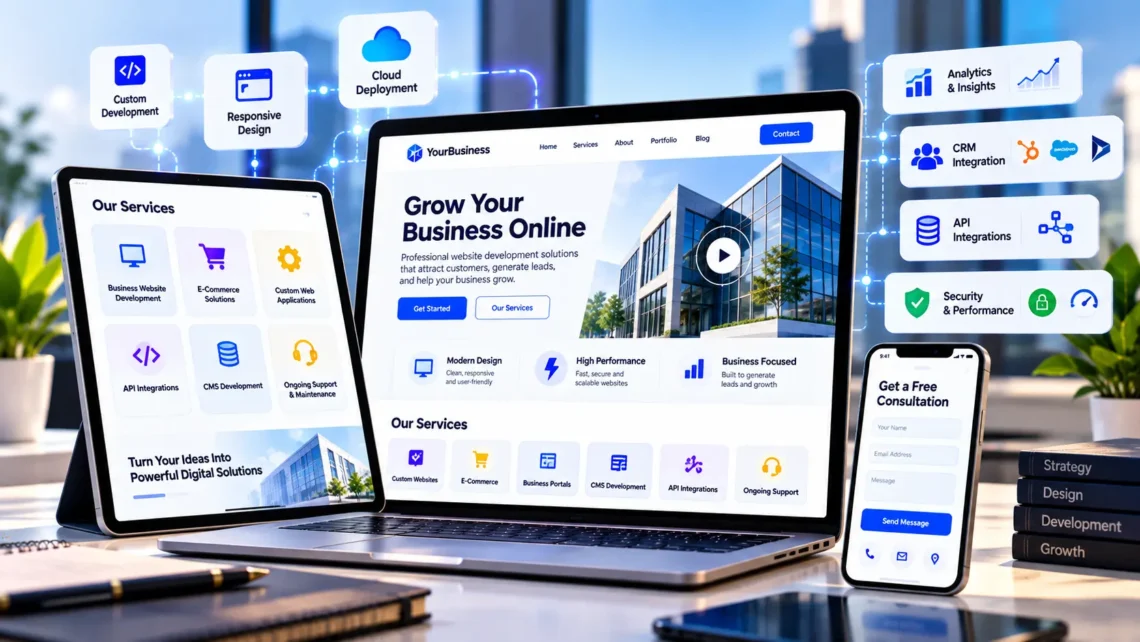
A business website is no longer just an online brochure. For many companies, it is the first place a potential customer evaluates the business, checks its services, compares alternatives, requests a quote, or decides whether to make contact.
Professional business website development services combine strategy, UX/UI design, development, integrations, security, performance, and ongoing maintenance to create a website that supports actual business objectives—not simply a visually attractive homepage.
For startups, small businesses, service companies, and established organizations, the right website architecture can make it easier to generate leads, manage content, connect business systems, and support future growth.
Quick Answer
Business website development services cover the planning, design, development, integration, testing, deployment, and maintenance of a website built around a company’s goals. A professional business website can include service pages, lead-generation forms, CMS functionality, APIs, CRM integrations, analytics, security, responsive design, and SEO-friendly architecture. The technology should match the company’s requirements, budget, users, and long-term roadmap.
What Are Business Website Development Services?
Business website development services involve creating a website specifically around an organization’s business objectives, customers, workflows, and technical requirements.
Unlike a basic template website, professional development can address:
- Business strategy
- Information architecture
- UI/UX design
- Custom functionality
- Content management
- Lead generation
- API integrations
- CRM integration
- Payment systems
- Booking systems
- Customer portals
- Analytics
- Security
- Performance
- SEO-friendly technical structure
- Cloud deployment
- Ongoing maintenance
The objective is to create a digital platform that supports the business rather than treating the website as an isolated marketing asset.
Why Businesses Need More Than a Basic Website?
A company can have a website and still struggle to generate meaningful business results.
Common problems include:
- The website does not clearly explain the services.
- Visitors cannot easily find important information.
- Contact forms do not connect with the sales process.
- The website is difficult to update.
- Pages load slowly.
- The mobile experience is poor.
- The design does not reflect the company’s positioning.
- The website cannot integrate with existing business systems.
- Adding new functionality requires rebuilding major parts of the site.
These problems are especially important when the website becomes part of the company’s sales and operations process.
A professional website should therefore be planned around the question:
What should this website help the business accomplish?
Business Website Development for Small Businesses
Small business website development does not necessarily mean building a smaller version of an enterprise website.
A small business often needs a focused website that does a few things extremely well.
Typical requirements may include:
- Homepage
- About page
- Service pages
- Product or portfolio pages
- Contact page
- Quote request form
- WhatsApp or communication integration
- Google Maps integration
- Reviews or testimonials
- Blog or resources
- Basic analytics
- CMS
For a local service business, the website may primarily need to generate calls and inquiries.
For an e-commerce business, product discovery and checkout may be more important.
For a B2B company, the website may need detailed service information, technical resources, lead forms, and CRM integration.
The scope should therefore be determined by the business model rather than by the number of pages alone.
Business Requirements for Website Development
Before development starts, businesses should document their actual requirements.
These can be divided into several categories.
Business Requirements
Define:
- What the company sells
- Who the target customers are
- Primary business goals
- Main conversion actions
- Geographic markets
- Sales process
- Required integrations
Functional Requirements
Determine what the website must actually do.
For example:
- User registration
- Login
- Booking
- Quote requests
- Product filtering
- Online payments
- Customer dashboards
- File uploads
- Search
- Forms
- Notifications
Technical Requirements
These can include:
- Hosting
- Database
- APIs
- CMS
- Security
- Authentication
- Performance
- Backups
- Integrations
- Analytics
Defining these requirements before development can reduce unnecessary rework later.
Website Development for Businesses: Choosing the Right Architecture
Not every business needs the same technology.
A simple marketing website may require a CMS and standard hosting.
A more advanced platform may require:
Frontend → Backend → API → Database → External Systems
For example:
Website → API → CRM → Sales Team
or:
Website → API → ERP → Inventory
The architecture should be selected according to the actual business requirements.
Overengineering a simple website can create unnecessary costs, while underengineering a complex platform can create technical limitations later.
.NET for Business Website Development
For companies requiring custom functionality or enterprise integrations, the .NET ecosystem can be considered as part of the technology stack.
C#
C# can be used for backend logic, APIs, services, integrations, and custom applications.
ASP.NET Core
ASP.NET Core can be used to develop modern web applications and APIs.
It can support requirements such as:
- Authentication
- Business logic
- APIs
- Database connectivity
- Custom workflows
- Third-party integrations
Azure
Microsoft Azure can provide cloud infrastructure for applications that require cloud-based hosting, storage, databases, monitoring, or other services.
Blazor
Blazor can be considered for certain interactive web interfaces, particularly where a business wants to use .NET technologies across more of the application.
.NET MAUI
For businesses that also require mobile applications, .NET MAUI may be evaluated for cross-platform application development where appropriate.
The important point is that .NET should be used where it makes sense for the project. A business website does not automatically need a custom .NET architecture.
Plumbing Business Website Development: A Practical Example
Plumbing business website development demonstrates why industry-specific requirements matter.
A plumbing company may need more than standard service pages.
Its website could include:
- Emergency plumbing services
- Service-area pages
- Plumbing service categories
- Request-a-quote forms
- Appointment booking
- Click-to-call functionality
- WhatsApp integration
- Customer reviews
- Before-and-after project galleries
- FAQ sections
- Location information
- CRM integration
For an emergency plumbing company, a prominent phone number and fast inquiry process may be more important than an elaborate visual experience.
For a commercial plumbing company, detailed service information, project capabilities, certifications, and quote requests may be more important.
The same principle applies to other industries.
The website should reflect how the business actually sells and serves customers.
Business Model for Website Development: What Should the Website Support?
A company’s website should reflect its business model for website development and broader commercial model.
Different businesses may require different digital journeys.
Service Business
Visitor → Service Information → Inquiry → Sales Team
E-Commerce Business
Visitor → Product → Cart → Checkout → Order
SaaS Company
Visitor → Product Information → Demo/Trial → Signup → Subscription
B2B Company
Visitor → Solutions → Resources → Qualification → Sales Conversation
Local Business
Visitor → Location/Service → Call/Message → Visit
Understanding this journey helps determine what features actually belong on the website.
Custom Website Development vs Website Builders
| Factor | Website Builder | Custom Development |
|---|---|---|
| Initial setup | Usually faster | Requires planning |
| Custom functionality | More limited | Can be designed around requirements |
| Integrations | Depends on available tools | Can be developed specifically |
| Design flexibility | Depends on platform | Greater control |
| Maintenance | Often platform-dependent | Requires development support |
| Scalability | Depends on platform | Can be architected around requirements |
| Technical control | Limited by platform | Greater control |
| Best suited for | Straightforward websites | Complex or specialized requirements |
Neither option is automatically right for every company.
A small company with straightforward requirements may not need extensive custom development.
A business with complex workflows, integrations, or a digital product may require a more customized architecture.
Essential Features of a Business Website
Responsive Design
The website should work effectively across desktop, tablet, and mobile screens.
Clear Navigation
Visitors should be able to understand the site’s structure quickly.
Strong Service Pages
Each important service should have enough information to answer customer questions and support the next action.
Lead Forms
Forms should capture useful information without making the inquiry process unnecessarily complicated.
CMS
A content management system can allow authorized staff to update website content without requiring development work for every small change.
Analytics
Analytics can help businesses understand website activity and identify areas for improvement.
Security
Security should be considered throughout development, particularly for websites handling customer information, accounts, payments, or business data.
Website Integrations for Businesses
A modern website often needs to connect with other business systems.
Common integrations include:
- CRM
- ERP
- Payment gateways
- Email platforms
- Marketing automation
- Accounting software
- Inventory systems
- Booking platforms
- Customer support tools
- Social platforms
- Analytics systems
For example:
Website → API → CRM
A visitor submits a quote request, the API processes the information, and the CRM receives the lead.
For businesses already using Microsoft technologies, C#, ASP.NET Core, APIs, and Azure can be used to develop supporting integration services where appropriate.
SEO and Business Website Development
SEO should be considered during development rather than added only after the website is launched.
Technical foundations can include:
- Logical URL structure
- Search-friendly page architecture
- Proper headings
- Metadata
- Internal linking
- Image optimization
- Mobile usability
- Page performance
- Structured data where appropriate
- Crawlable content
- XML sitemap
- Canonicalization where required
The development team and SEO team should ideally work together.
A website that looks good but creates technical barriers for search engines can require unnecessary redevelopment later.
Business Website Development Costs
There is no universal price for business website development services.
Cost depends on the scope and complexity of the project.
| Requirement | Potential Cost Impact |
|---|---|
| Number of pages | More content can increase design and development work |
| Custom UI/UX | Complex interfaces require additional design effort |
| CMS | Depends on platform and customization |
| Custom functionality | Increases development scope |
| API integrations | Depends on systems and data requirements |
| E-commerce | Adds products, checkout, payments, orders, and related functionality |
| Customer portal | Requires authentication and account functionality |
| Mobile application | Adds another development platform |
| Cloud infrastructure | Depends on architecture and requirements |
| Ongoing maintenance | Depends on support scope |
A practical approach is to divide the project into:
Discovery → Design → Development → Testing → Launch → Maintenance
For larger projects, an MVP can be developed first before expanding the platform.
Common Business Website Development Mistakes
1. Starting With Design Instead of Requirements
A visually attractive website can still fail if it does not support the company’s sales process.
2. Trying to Serve Everyone
A website becomes harder to understand when it tries to communicate with every possible audience at once.
3. Ignoring Mobile Users
Responsive design should be part of the initial development process.
4. Adding Too Many Features
Every feature adds development, testing, maintenance, and potentially security requirements.
5. Ignoring Integrations
If the sales team depends on a CRM, the website should be planned around that workflow.
6. No Content Strategy
A website needs useful content to explain services, answer questions, and support customer decisions.
7. No Maintenance Plan
Websites require updates, security reviews, bug fixes, performance monitoring, and content improvements.
Best Practices for Website Development for Businesses
Start With the Business Goal
Define whether the website’s primary role is lead generation, sales, bookings, customer support, information, or another objective.
Build Around the User Journey
Map what a visitor needs to know before becoming a customer.
Keep the Architecture Maintainable
Avoid unnecessary complexity that makes future changes expensive.
Plan Integrations Early
CRM, ERP, payment, booking, and other integrations should be considered during architecture.
Treat Security as a Requirement
Authentication, authorization, secure APIs, backups, and data protection should be planned from the beginning.
Make the CMS Practical
Business teams should be able to manage content efficiently.
Design for Growth
The website should have a clear path for future features without requiring an unnecessary rebuild.
How to Choose a Business Website Development Company?
Before hiring a development partner, ask:
Do they understand your business?
A developer should understand what the website needs to accomplish.
Can they handle custom functionality?
If your requirements go beyond standard templates, confirm that the team can build and maintain custom features.
Can they integrate existing systems?
Ask about CRM, ERP, payment, booking, and API integration experience.
How do they handle security?
Understand their approach to authentication, authorization, data protection, backups, and secure development.
What happens after launch?
Clarify maintenance, support, monitoring, updates, and future development.
Business Website Development Services at DotNetDevelopers.us
DotNetDevelopers.us can support businesses that need websites and custom digital platforms built around their actual requirements.
Relevant capabilities can include:
- Business website development
- Custom web applications
- C# development
- ASP.NET Core
- API development
- CRM and ERP integrations
- Azure cloud solutions
- SaaS development
- E-commerce development
- Mobile application development
- Application modernization
- Ongoing maintenance and support
For an existing website, a technical assessment can examine the current architecture, performance, security, integrations, CMS, and opportunities for modernization.
Planning a new business website? Start with the business requirements before choosing the technology. A technical consultation can help define the scope, architecture, integrations, and development roadmap.
When Should You Build a Custom Business Website?
Custom development can make sense when:
- Your business has unique workflows.
- Existing website platforms cannot support required functionality.
- You need multiple business-system integrations.
- Your website is becoming a core operational platform.
- You need customer or employee portals.
- You require custom APIs.
- Your existing website is difficult to maintain.
- You are building a digital product rather than a simple marketing website.
For a straightforward informational website, a simpler platform may be more appropriate.
The goal should be to choose the simplest architecture that can reliably support the business requirements.
Frequently Asked Questions
What are business website development services?
Business website development services include planning, UI/UX design, development, CMS implementation, integrations, testing, deployment, security, performance optimization, and ongoing maintenance for business websites and web applications.
How much does business website development cost?
The cost depends on the number of pages, design complexity, custom functionality, CMS requirements, integrations, e-commerce features, customer portals, infrastructure, and ongoing support. A defined scope provides a more useful basis for estimation.
What is small business website development?
Small business website development focuses on creating a website around the specific needs of a smaller organization, often emphasizing services, local visibility, lead generation, contact options, mobile usability, and simple content management.
What should a business website include?
A business website commonly includes a clear homepage, service or product pages, about information, contact options, lead forms, responsive design, navigation, relevant content, analytics, security, and a manageable content system. Additional features depend on the business.
Is .NET suitable for business website development?
.NET can be suitable for businesses that require custom web applications, APIs, integrations, enterprise workflows, SaaS platforms, or Microsoft-based technology environments. C#, ASP.NET Core, Azure, and related technologies can be used where appropriate.
Should a small business build a custom website?
Not every small business needs a fully custom application. The decision should depend on business requirements, integrations, workflows, expected growth, budget, and the level of customization required.
How long does business website development take?
There is no universal timeline. A straightforward business website may require significantly less development work than a website involving e-commerce, customer portals, APIs, ERP/CRM integrations, or custom workflows. Discovery and scope definition should happen before setting a development timeline.
Conclusion
A successful business website needs to do more than present information.
It should support the way the company attracts customers, explains its services, generates leads, communicates with internal systems, and grows over time.
Professional business website development services can combine strategy, UX/UI, development, APIs, integrations, security, SEO-friendly architecture, cloud infrastructure, and ongoing maintenance into one structured solution.
For smaller organizations, website development for small businesses can focus on generating leads and communicating services clearly. For larger businesses, the website may become part of a broader technology ecosystem involving CRM, ERP, APIs, cloud systems, customer portals, and custom applications.
Technologies such as C#, ASP.NET Core, Azure, Blazor, and .NET MAUI can be used where they match the project’s technical requirements.
DotNetDevelopers.us helps businesses plan, develop, integrate, and modernize web solutions around their specific business requirements.
Need a new website or want to modernize an existing one?
Contact DotNetDevelopers.us for a consultation, technical assessment, or discussion about your next development project.


