
Last updated: November 2026 Choosing a technology stack is only one part of building successful software. The bigger challenge is finding a development partner that understands your business requirements, designs the right architecture, builds securely, and can support the application after launch. Many businesses begin with a simple requirement: “We need a web application.” But a production application rarely stays that simple. It may require APIs, authentication, databases, cloud infrastructure, mobile applications, third-party integrations, reporting, security controls, monitoring, analytics, and continuous maintenance. This is where .NET software development services can provide a complete engineering foundation. Modern .NET can support web applications, APIs, enterprise platforms, SaaS products, cloud applications, mobile applications, integrations, and legacy modernization. However, choosing .NET alone does not guarantee a successful project. Architecture, development practices, security, testing, performance, deployment, and long-term maintenance all influence the final outcome. This guide explains what .NET software development services include, why businesses choose .NET, what companies can build with it, how modernization works, what affects development cost, and how to choose the right .NET development company.
Quick Answer: What Are .NET Software Development Services?
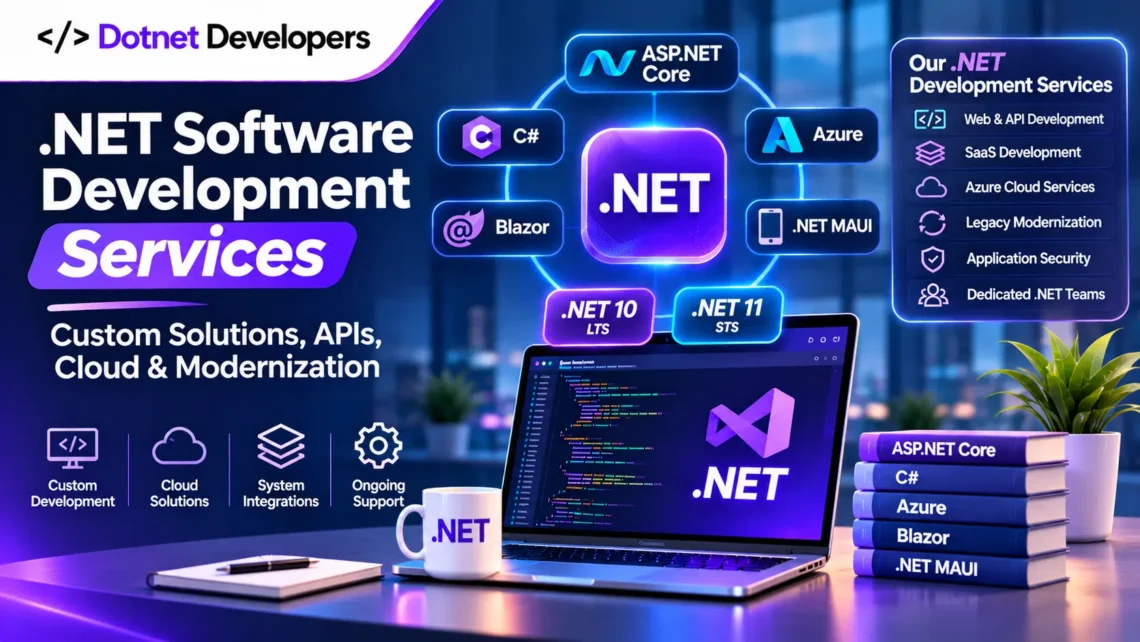
.NET software development services are professional services for designing, developing, integrating, modernizing, deploying, and maintaining software using Microsoft’s .NET ecosystem. Depending on business requirements, services can include C# development, ASP.NET Core, API development, SaaS applications, enterprise software, Azure cloud solutions, Blazor, .NET MAUI, database development, third-party integrations, legacy modernization, security, performance optimization, and dedicated .NET development teams.
- .NET software development services cover the full lifecycle: discovery, architecture, development, testing, deployment, modernization, and support.
- .NET can support web apps, APIs, SaaS, enterprise software, cloud workloads, mobile apps, and integrations.
- As of November 2026, .NET 10 (LTS) and .NET 11 (STS) are supported. .NET 8 and .NET 9 reached end of support on November 10, 2026.
- Choosing .NET alone does not guarantee success. Architecture, security, testing, and maintenance matter just as much.
- Compare partners on total cost of ownership, not just the initial quote.
- Start with a technical discovery before committing to a development budget.
What Are .NET Software Development Services?
.NET software development services cover the complete software lifecycle, from technical discovery and architecture through development, testing, deployment, modernization, and ongoing support. A .NET development engagement may include:
- Custom .NET application development
- C# development
- ASP.NET Core development
- Web application development
- REST API development
- Enterprise software development
- SaaS development
- Azure cloud development
- Blazor development
- .NET MAUI application development
- Database development and Entity Framework Core
- Third-party API integrations
- CRM and ERP integrations
- Legacy application modernization
- .NET migration
- Application security
- Performance optimization
- Testing and QA
- CI/CD implementation
- Maintenance and support
- Dedicated .NET developers
- Staff augmentation
- .NET consulting
The exact scope should depend on the business problem. A startup building a SaaS product may need a compact product team, while an established company modernizing a legacy platform may require architecture, migration, integration, testing, cloud engineering, and long-term support. The goal should not be to purchase a list of technologies. The goal should be to build software that solves a defined business problem.
Why Do Businesses Choose .NET?
.NET is Microsoft’s broad development platform for building different types of applications and services. Its value for businesses comes from the ability to use a mature ecosystem across backend development, web applications, APIs, cloud workloads, mobile applications, and enterprise software.
1. Enterprise Application Development
Enterprise applications often require more than basic data entry and CRUD functionality. They may need:
- Role-based access, authentication, and authorization
- Complex business rules
- Multiple user types
- Database integration
- Audit trails
- APIs and reporting
- External integrations
- Monitoring and security controls
- Long-term maintenance
.NET can support these requirements when the application architecture is appropriately designed.
2. Web Application Development
ASP.NET Core provides a foundation for modern web applications and backend services. Businesses can use it for:
- Customer portals
- Employee platforms
- SaaS products
- Booking systems
- E-commerce platforms
- Management dashboards
- Enterprise portals
- Business automation systems
- Internal applications
ASP.NET Core supports modern application patterns including web APIs, Minimal APIs, Blazor, SignalR, authentication, authorization, dependency injection, logging, and diagnostics. The framework should still be selected according to the application’s requirements rather than simply because it is popular.
3. API Development
Modern businesses rarely operate through a single isolated application. A typical architecture may look like:
Web Application → API → Database
Mobile Application → API
Third-Party Platform → API → Business System
.NET can be used to build APIs and services that allow different applications and systems to communicate. Common integration scenarios include:
- CRM systems
- ERP platforms
- Payment providers
- Accounting software
- Mobile applications
- Partner platforms
- Internal business applications
- E-commerce systems
Good API architecture should consider:
- Authentication and authorization
- Validation and error handling
- Versioning
- Logging and monitoring
- Documentation
- Rate limiting where appropriate
- Data consistency
Current .NET Versions and Support
Version strategy matters when starting a new project or modernizing an existing application. As of November 2026, Microsoft’s support policy lists:
| .NET Version | Release Type | Current Status | End of Support |
|---|---|---|---|
| .NET 11 | STS | Active | November 2028 |
| .NET 10 | LTS | Active | November 14, 2028 |
| .NET 9 | STS | Out of support | November 10, 2026 |
| .NET 8 | LTS | Out of support | November 10, 2026 |
Microsoft releases major .NET versions annually, with LTS releases receiving three years of support and STS releases receiving two years. For businesses starting a new long-lived application, .NET 10 LTS can be an important option when longer support duration is a priority. .NET 11 is also actively supported for teams that want the newer STS release. The appropriate version should ultimately depend on project requirements, dependencies, compatibility, and upgrade strategy.
Core Technologies in Modern .NET Development
A professional .NET development project may involve several technologies.
C#
C# is the primary programming language used across modern .NET development. It can be used for:
- Business logic
- APIs and backend services
- Cloud applications
- Database interactions
- Desktop applications
- Blazor applications
- Cross-platform applications
- AI-enabled applications
However, programming language selection is only one part of software architecture.
ASP.NET Core
ASP.NET Core is Microsoft’s web framework for building modern web applications and services. It can support:
- REST APIs and Minimal APIs
- MVC applications
- Authentication and authorization
- Real-time applications
- Backend services
- Blazor applications
- Enterprise web applications
It is particularly useful when a business needs a backend that can serve multiple clients, applications, or integrations.
Blazor
Blazor enables developers to build interactive web user interfaces using .NET and C#. Potential business use cases include:
- Internal dashboards
- Enterprise portals
- Administrative systems
- Business management applications
- Data-heavy interfaces
- Customer portals
The frontend technology should still be selected based on UX requirements, performance, team expertise, application architecture, and product goals.
.NET MAUI
.NET MAUI is Microsoft’s framework for building native cross-platform applications using C# and XAML. It supports application development for Android, iOS, macOS, and Windows. For a mobile project, architecture should also consider:
- Offline behavior
- Device capabilities
- Authentication and security
- Push notifications
- API communication
- Application-store requirements
- Performance
Microsoft Azure
Azure can provide cloud infrastructure and managed services for .NET applications. Depending on the architecture, a solution may use cloud services for:
- Application hosting
- Databases and storage
- Authentication
- Networking
- Monitoring
- Messaging
- Backups
- Application integration
Moving an application to the cloud should not simply mean moving an existing server into a cloud environment. The architecture should be reviewed for scalability, security, reliability, observability, performance, cost management, and disaster recovery.
What Can a .NET Development Company Build?
A modern .NET development company can build many types of business software.
SaaS Platforms
.NET can support SaaS applications involving:
- User accounts
- Subscription management
- Dashboards
- APIs
- Billing integrations
- Multi-tenant architecture
- Reporting and administration
- Role-based access
SaaS architecture should consider tenant isolation, permissions, scalability, deployment, monitoring, data management, and future product changes.
Enterprise Portals
Businesses may need portals for employees, customers, vendors, partners, administrators, and field teams. A portal can connect several business processes through one controlled interface.
Custom Business Applications
Custom .NET applications can be useful when generic software cannot properly support a company’s workflows. Examples include:
- Management systems
- Booking platforms
- Logistics software
- Healthcare platforms
- Education systems
- CRM solutions
- Inventory applications
- Restaurant software
- Hotel management systems
- Financial business applications
The value of custom software comes from solving a specific business problem, not from building custom software simply because it is possible.
.NET Software Development vs Buying Existing Software
Before starting custom development, businesses should evaluate whether they actually need custom software.
| Existing software may be better when… | Custom .NET development may be better when… |
|---|---|
| Your requirements are standard | Your workflows are unique |
| A mature product already solves the problem | Existing products do not integrate properly with your systems |
| You need implementation quickly | You need custom APIs |
| Customization requirements are limited | You require complete control over the product roadmap |
| You do not want to manage software development internally | The software provides competitive differentiation |
| Your reporting needs are standard | You have specialized reporting requirements |
| You are not modernizing an existing application | You need to modernize an existing application |
The correct question is not “Can we build this?” It is: “Does building this create enough business value to justify the investment?”
.NET Modernization and Legacy Application Migration
.NET modernization is the planned process of moving an existing application to supported, maintainable technology while controlling business risk. Many businesses are not starting from zero. They already have software, but the application may be:
- Difficult to maintain
- Running on outdated technology
- Expensive to modify
- Difficult to integrate
- Missing modern security controls
- Difficult to deploy
- Dependent on outdated infrastructure
- Lacking automated tests
A complete rewrite is not always the safest solution. A modernization project can follow:
Assessment → Architecture → Refactoring → Migration → Testing → Deployment → Monitoring
For business-critical applications, a phased approach can reduce operational risk. A modernization assessment should examine:
- Current .NET version
- Framework dependencies
- Third-party packages
- Database architecture
- Authentication
- APIs
- Infrastructure
- Deployment process
- Testing coverage
- Security and monitoring
- Business-critical workflows
If an application is still running on .NET 8 or .NET 9, version planning deserves particular attention because both reached end of support on November 10, 2026.
.NET Integration Services
Businesses rarely operate with one software system. A typical technology ecosystem may look like:
CRM ↔ API ↔ ERP ↔ Payment Platform ↔ Customer Application
.NET integration services can connect these systems through APIs, middleware, background services, messaging, or other appropriate integration patterns. Common scenarios include:
- CRM and ERP integration
- Payment integration
- Accounting integration
- Microsoft Dynamics integration
- SharePoint integration
- Database integration
- Third-party APIs
- Mobile application integration
- E-commerce integration
Integration architecture should consider more than simply connecting two systems. It should address:
- Authentication
- Data validation
- Error handling and retries
- Duplicate requests
- Synchronization
- Logging and monitoring
- Data consistency
- Failure recovery
This becomes especially important when integrations handle financial, customer, or operational data.
Security in .NET Application Development
Security should be part of application architecture from the beginning.
Authentication
Who is allowed to access the system?
Authorization
What can each user do after signing in?
API Security
How are APIs authenticated, authorized, rate-limited, and protected?
Data Protection
Which customer and business information requires additional protection?
Audit Logging
Which sensitive actions need to be recorded? Examples may include:
- Permission changes
- Financial transactions
- Data exports
- Administrative actions
- Configuration changes
- Password or authentication changes
Dependency Management
Applications depend on frameworks, packages, libraries, containers, and infrastructure. Those dependencies need to be monitored and updated throughout the software lifecycle. Security is not a feature that is completed once. It is an ongoing engineering responsibility.
Performance, Scalability and Reliability
A production .NET application should be designed around expected workloads and business requirements. Performance planning can involve:
- Database optimization
- API performance
- Caching
- Background processing
- Resource management
- Load testing
- Query optimization
- Application profiling
Scalability planning should consider:
- Expected users
- Traffic patterns
- Data volume
- Concurrent requests
- Geographic distribution
- Third-party dependencies
- Infrastructure limits
Reliability also requires operational visibility. That means considering logging, metrics, tracing, alerts, health checks, monitoring, backup, and recovery procedures. A scalable architecture is not simply one with more servers. It is an architecture designed around actual workload and failure requirements.
How Much Do .NET Software Development Services Cost?
There is no universal price for .NET development. A simple internal business application and a multi-tenant enterprise SaaS platform can both use ASP.NET Core while requiring very different budgets. Cost can depend on:
- Number of features
- Application complexity
- User roles
- Integrations
- Mobile requirements
- Cloud infrastructure
- Database architecture
- Security requirements
- UX/UI complexity
- Testing
- Migration requirements
- Team size and developer seniority
- Project duration
- Ongoing maintenance
The engagement model also affects cost. Businesses may work with:
- Individual developers
- Dedicated developers
- Staff augmentation
- Project-based teams
- Dedicated delivery squads
- Consulting and implementation teams
A serious development partner should understand the requirements and architecture before providing a detailed estimate.
Why the Cheapest Development Quote Can Become Expensive?
The lowest initial quote does not necessarily produce the lowest total cost. Poor architecture can create technical debt, security issues, slow development, difficult integrations, expensive maintenance, performance problems, and upgrade difficulties. A better business calculation is:
Development Cost + Infrastructure + Maintenance + Security + Upgrades + Future Change
This is the total cost of ownership of the software. When comparing development partners, businesses should evaluate the long-term cost of operating and changing the application, not just the initial development price.
Common Mistakes When Hiring a .NET Development Company
1. Choosing Based Only on Price
Price matters, but it should not be the only selection criterion. Technical debt can make a cheap project expensive later.
2. Starting Development Without Discovery
Without understanding requirements, integrations, users, and constraints, it is difficult to design the right architecture.
3. Focusing on Technology Instead of Business Outcomes
A long list of technologies does not guarantee a successful product. Ask:
- What problem are we solving?
- Who uses the system?
- What processes are being automated?
- What systems need to integrate?
- What happens when something fails?
- How will success be measured?
4. Ignoring Maintenance
Production software requires ongoing security updates, dependency upgrades, monitoring, bug fixes, performance optimization, infrastructure maintenance, and integration updates.
5. Building Everything at Once
A large first release can increase cost and risk. An MVP or phased delivery model can help validate the most important workflows before investing heavily in secondary functionality.
6. Not Defining Ownership
Before development begins, clarify:
- Who owns the source code?
- Who owns the cloud infrastructure?
- Who controls the repositories?
- Who manages deployments?
- Who documents the system?
- Who handles production incidents?
These responsibilities should be clear contractually and technically.
How to Choose the Right .NET Software Development Company?
Choosing a development partner should involve more than checking whether the company lists “.NET” on its website.
Technical Expertise
Ask about experience with C#, ASP.NET Core, APIs, Azure, databases, authentication, cloud architecture, testing, CI/CD, modernization, performance, and security.
Architecture Capability
A strong team should be able to explain:
- Why a particular architecture is appropriate
- What trade-offs exist
- How the system will scale
- How failures will be handled
- How integrations will work
- How future upgrades will be managed
Business Understanding
The best development teams do not simply convert every requirement into code. They ask why a feature is needed, identify unnecessary complexity, identify technical risks, and connect technical decisions to business objectives.
Communication
Successful software development requires communication between business stakeholders, product managers, designers, developers, QA, and infrastructure teams. Clear communication should be part of the delivery process.
Post-Launch Support
Ask what happens after deployment. A production application needs a plan for monitoring, bug fixes, security, updates, performance, infrastructure, new integrations, and future development.
When Should You Hire a .NET Development Consultant?
A dot net development consultant can be useful when a business needs technical direction before committing to a development roadmap. Consulting can help with:
- Architecture reviews
- Technology selection
- Legacy assessment
- Migration planning
- Security reviews
- Cloud strategy
- Performance diagnosis
- API architecture
- Development team planning
- Technical due diligence
- Software modernization
For example, if a company has a legacy .NET application and is unsure whether to rewrite, migrate, or incrementally modernize it, a technical assessment can clarify the available options and risks.
A Practical .NET Software Development Process
A structured process can reduce unnecessary development risk.
| Phase | What Gets Defined or Done |
|---|---|
| 1. Discovery | Business objectives, users, workflows, functional requirements, integrations, security requirements, technical constraints |
| 2. Architecture | Application structure, database, APIs, authentication, authorization, cloud infrastructure, integration strategy, deployment approach |
| 3. UX/UI | Critical user journeys designed before development progresses too far |
| 4. MVP Development | Core business functionality built first |
| 5. Testing | Functional workflows, APIs, security, permissions, performance, error handling, integrations, critical business scenarios |
| 6. Deployment | CI/CD, monitoring, logging, backups, infrastructure, production access, rollback procedures |
| 7. Continuous Improvement | Security updates, performance optimization, feature development, dependency upgrades, modernization, integration maintenance |
This creates a clearer path from business requirement to architecture, development, production, and continuous improvement.
.NET for AI-Powered Applications
Modern .NET applications can also incorporate AI capabilities when there is a clear business use case. A .NET application can be integrated with:
- AI APIs
- Large language models
- AI assistants
- RAG systems
- Vector search and semantic search
- Document processing
- Intelligent automation
For example, an enterprise application could combine:
ASP.NET Core → Business Logic → AI Integration → Enterprise Data → Secure User Interface
The important principle is that AI should solve a defined business problem rather than being added simply because it is technically possible.
Why Choose DotNetDevelopers.us?
DotNetDevelopers.us focuses on .NET engineering and related Microsoft technologies. Its service areas include:
- ASP.NET Core
- C#
- Azure
- Blazor
- .NET MAUI
- Entity Framework Core
- SQL Server
- API development
- System integrations
- Legacy modernization
- Custom .NET development
- .NET consulting
- Maintenance and support
- Dedicated .NET developers
For a business, the important question is not simply whether developers can write C#. The more important question is whether the development partner can understand:
Business requirements + Architecture + Security + Integrations + Development + Deployment + Long-Term Maintenance
If you are planning a new .NET application, modernizing an existing platform, building APIs, migrating to Azure, or adding .NET engineering capacity, a technical discovery can help establish the right development approach before significant investment begins.
.NET Software Development Services: Build for the Full Lifecycle
.NET software development services can cover far more than application coding. A complete engagement may involve:
Strategy → Discovery → Architecture → Development → APIs → Cloud → Security → Testing → Deployment → Maintenance
The right approach depends on the business:
- A startup may need an MVP and a small product team.
- An enterprise may need modernization, integrations, cloud architecture, security, and ongoing engineering support.
- A company with an existing engineering department may only need specialized .NET developers or staff augmentation.
There is no single engagement model that fits every organization. The important decision is to match the development model, architecture, technology, and team structure to the business roadmap. For organizations already using Microsoft’s ecosystem, .NET can provide a broad foundation for web applications, APIs, SaaS products, enterprise platforms, cloud workloads, mobile applications, and modernization projects. But technology alone does not create successful software. Good software comes from clear requirements, appropriate architecture, disciplined engineering, security, testing, monitoring, and continuous improvement. If your business is considering a new application, legacy modernization, API platform, Azure migration, AI-enabled application, or additional .NET engineering capacity, start with the technical problem, not just the technology.
What are .NET software development services?
.NET software development services include designing, developing, integrating, deploying, modernizing, and maintaining software using Microsoft’s .NET ecosystem. Services can include C#, ASP.NET Core, APIs, Azure, Blazor, .NET MAUI, SaaS platforms, enterprise applications, integrations, and legacy modernization.
What does a .NET development company do?
A .NET development company helps businesses build or improve software using .NET technologies. Depending on the project, this can include custom applications, web development, APIs, cloud solutions, integrations, modernization, security, maintenance, consulting, and dedicated development teams.
Is .NET suitable for enterprise software?
Yes. .NET can support enterprise applications requiring authentication, authorization, databases, APIs, integrations, reporting, security controls, cloud infrastructure, and long-term maintenance. The application’s architecture and engineering practices are as important as the framework itself.
What is the difference between .NET and ASP.NET Core?
.NET is the broader development platform and ecosystem. ASP.NET Core is the web framework within the .NET ecosystem used to build web applications, APIs, and web-based services.
Is .NET 10 still supported?
Yes. Microsoft currently lists .NET 10 as an active Long-Term Support release with support through November 14, 2028. .NET 11 is also currently active as an STS release, with support through November 2028.
How much do .NET software development services cost?
There is no standard price. Cost depends on application complexity, features, integrations, architecture, security requirements, team size, cloud infrastructure, testing, migration requirements, project duration, and ongoing support.
When should a company hire a .NET development consultant?
A .NET consultant can help with architecture reviews, legacy modernization, migration planning, cloud strategy, security assessments, API architecture, performance issues, technology decisions, and technical planning before a major development project.
Can .NET be used for mobile applications?
Yes. .NET MAUI supports cross-platform native application development for Android, iOS, macOS, and Windows using C# and XAML.
Can .NET applications integrate AI?
Yes. .NET applications can integrate AI APIs, language models, RAG systems, vector search, semantic search, AI assistants, document processing, and intelligent automation when these capabilities support a defined business requirement.


