
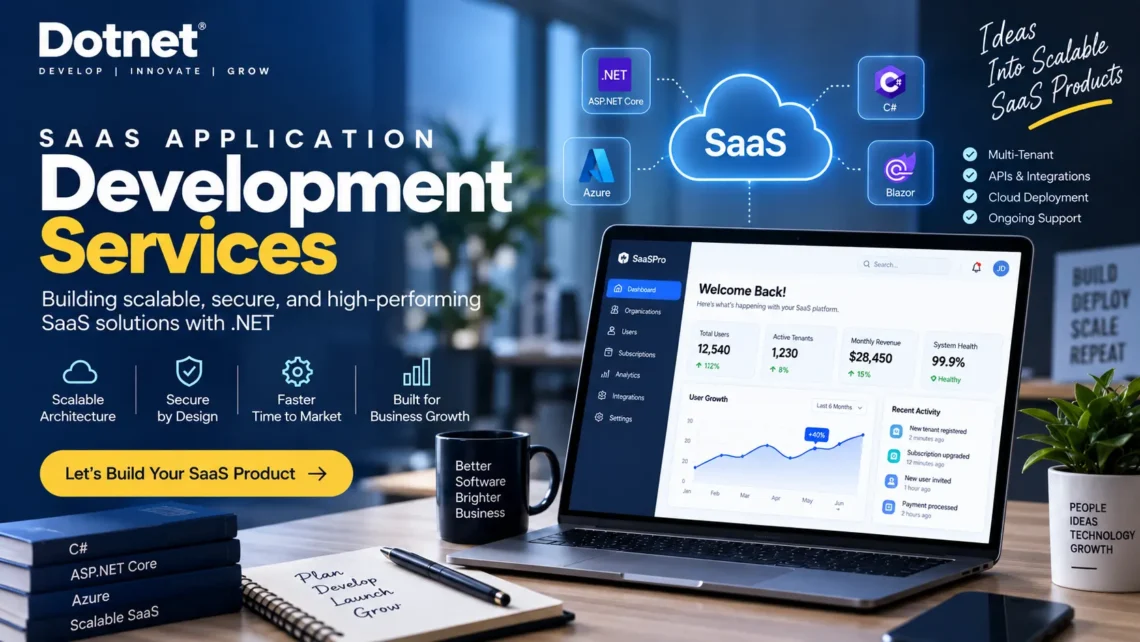
When a SaaS product starts gaining users, technical weaknesses become business problems. Slow releases, complicated billing, poor tenant isolation, difficult integrations, and an architecture that cannot scale can make it harder to grow the product.
A reliable SaaS development company helps businesses address these challenges from the beginning by designing software around scalability, security, usability, integrations, and long-term maintainability.
For organizations building a new SaaS product or modernizing an existing platform, a specialized SaaS application development company can provide the technical expertise required to turn a product concept into a dependable cloud-based application.
Quick Answer
A SaaS development company designs and builds cloud-based software that customers access through the internet, usually through a subscription or recurring commercial model. SaaS application development can include product architecture, multi-tenant systems, APIs, authentication, billing integrations, cloud deployment, security, dashboards, and ongoing maintenance. .NET technologies such as C#, ASP.NET Core, Azure, and Blazor can support many SaaS application requirements.
What Is SaaS Application Development?
Software as a Service, or SaaS, is a software delivery model where users access an application remotely rather than installing and managing the complete application on their own infrastructure.
Examples of SaaS product categories include:
- CRM platforms
- Project management software
- Accounting applications
- HR platforms
- Booking systems
- Healthcare software
- Education platforms
- Marketing tools
- Business management systems
- Industry-specific applications
A SaaS application typically combines a web interface, backend services, databases, APIs, authentication, infrastructure, monitoring, and other supporting systems.
The development challenge is therefore broader than simply building a website.
A SaaS product needs an architecture capable of supporting users, data, permissions, integrations, updates, and future product requirements.
Why Businesses Invest in Custom SaaS Development?
Ready-made software can be useful when a business has standard requirements. However, some organizations have workflows that existing platforms cannot support effectively.
Custom SaaS development can be considered when:
- The business has a unique operating model.
- Existing platforms require excessive workarounds.
- The software itself is part of the company’s product offering.
- A company wants to commercialize its own software.
- Multiple customer organizations need access to the same platform.
- The application requires specialized integrations.
- The product needs a highly customized user experience.
The important question is not whether custom software is technically possible.
It is whether the software creates enough business value to justify custom development.
What Does a SaaS Development Company Build?
A professional SaaS solutions company may handle several layers of a product.
1. SaaS Product Architecture
Architecture determines how different parts of the application communicate and how the platform can evolve.
A typical architecture may include:
Frontend → API Layer → Application Services → Database → External Services
Depending on the product, additional components may include:
- Authentication services
- Background processing
- File storage
- Notification systems
- Payment integrations
- Analytics
- Monitoring
- Third-party APIs
Architecture should be designed around the actual requirements rather than adding unnecessary complexity.
2. Multi-Tenant SaaS Applications
Multi-tenancy is an important consideration for many SaaS products.
A multi-tenant application allows multiple customers or organizations to use the same software platform while keeping their data and access appropriately separated.
The architecture must carefully consider:
- Tenant identification
- Data isolation
- User permissions
- Authentication
- Authorization
- Database design
- Administrative access
- Reporting
- Logging
Tenant isolation is not simply a database configuration issue. It should be considered throughout the application architecture.
3. User Authentication and Authorization
SaaS products commonly have multiple types of users.
For example:
- Account owner
- Administrator
- Manager
- Employee
- Customer
- Support user
Each role may require different permissions.
A SaaS application therefore needs a clear authorization model that determines what users can access and which actions they can perform.
This becomes particularly important when the application handles confidential business information.
.NET for SaaS Application Development
The .NET ecosystem provides several technologies that can be used when building SaaS applications.
C#
C# is commonly used for application logic and backend development within the .NET ecosystem.
It can be used to build:
- Business logic
- APIs
- Services
- Data-access layers
- Background processes
- Integration components
ASP.NET Core
ASP.NET Core can be used to develop modern web applications and APIs.
For SaaS platforms, it can support backend functionality such as:
- Authentication
- Business workflows
- REST APIs
- Data processing
- Integration services
- Administrative functionality
Azure
Microsoft Azure can provide cloud infrastructure and services for .NET applications.
Depending on project requirements, an architecture may use cloud services for:
- Application hosting
- Databases
- Storage
- Monitoring
- Security
- Deployment
- Scaling
The specific Azure services should be selected according to application requirements rather than simply using every available cloud service.
Blazor
Blazor can be considered for web user interfaces where a business wants to use .NET technologies across more of the application stack.
It can be useful for certain dashboards, internal platforms, and business applications.
Key SaaS Application Features
The exact features depend on the product, but many SaaS platforms require a combination of the following.
Account Management
Customers can create and manage their organizations, users, profiles, and settings.
Role-Based Access
Different users receive permissions based on their roles.
Dashboard
Users can see relevant information, activity, metrics, and workflows from a centralized interface.
Subscription Management
If the product uses subscriptions, the platform may need plans, billing integrations, upgrades, cancellations, and account status management.
Notifications
Applications can provide email, in-app, or other notifications based on product requirements.
Reporting
Business users may need reports, exports, filters, and dashboards.
API Integration
APIs can connect the SaaS platform with external systems such as CRM, ERP, payment, accounting, or communication platforms.
SaaS Development Process
A structured development process reduces the risk of building the wrong product.
Step 1: Requirement Discovery
Before development begins, define:
- Target users
- Business problem
- Core workflows
- Required integrations
- Security requirements
- Expected user roles
- MVP scope
Step 2: Product and Technical Architecture
The development team defines how the application will work technically.
This includes:
- Application architecture
- Database design
- API structure
- Authentication
- Tenant model
- Infrastructure
- Security approach
Step 3: MVP Development
The first release should focus on the essential functionality required to validate the product.
Avoid building every possible feature before users have an opportunity to use the product.
Step 4: Testing
Testing should cover areas such as:
- Functional behavior
- Authentication
- Authorization
- API behavior
- Data isolation
- Performance
- Security
- Cross-device usability
Step 5: Cloud Deployment
The application can then be deployed to the selected infrastructure with appropriate monitoring, backups, logging, and operational processes.
Step 6: Continuous Improvement
SaaS products evolve after launch.
Future work may include:
- New features
- Integrations
- Performance improvements
- Security updates
- UX improvements
- Reporting
- Mobile applications
SaaS Application Development Costs
There is no single price for SaaS development.
The total cost depends on the scope and technical complexity of the product.
Important cost factors include:
| Factor | Potential Impact |
|---|---|
| Number of features | More functionality increases development effort |
| User roles | Complex permissions require additional architecture |
| Multi-tenancy | Requires careful data and access design |
| Integrations | Each external system can introduce additional work |
| UI/UX complexity | Advanced interfaces require more design and development |
| Mobile applications | Additional platforms increase scope |
| Security requirements | Sensitive applications may require additional controls |
| Cloud infrastructure | Ongoing infrastructure requirements vary by architecture |
| Maintenance | SaaS products require continued technical support |
A useful approach is to separate the project into MVP, post-launch improvements, and long-term roadmap rather than trying to estimate an entire product based only on a feature list.
Common SaaS Development Risks
Building Too Many Features
A large initial scope can increase cost and delay the first usable release.
Poor Tenant Isolation
For multi-tenant applications, data separation must be designed carefully.
Weak Authentication and Authorization
Poor access controls can expose sensitive business information.
Ignoring Integrations
Third-party integrations should be considered during architecture rather than treated as an afterthought.
Overengineering
Adding unnecessary microservices or infrastructure can increase complexity without providing meaningful business value.
Neglecting Maintenance
A SaaS application needs updates, monitoring, bug fixes, security improvements, and ongoing development after launch.
Best Practices for SaaS Development
A strong SaaS development strategy should consider:
Design for Scalability
Plan for growth while avoiding unnecessary complexity in the first version.
Keep Security in the Architecture
Authentication, authorization, data protection, logging, and secure API design should be considered from the beginning.
Build Reusable APIs
A well-structured API can make future web, mobile, and third-party integrations easier.
Prioritize Observability
Logging and monitoring help development and operations teams understand application behavior.
Automate Deployment
Appropriate CI/CD practices can help teams deliver changes consistently.
Plan for Product Evolution
The architecture should allow new features and integrations to be added without repeatedly rebuilding the foundation.
When Should You Hire a SaaS Development Company?
Working with a specialized SaaS application development company can make sense when your internal team lacks the required technical capacity or when the product requires specialized architecture expertise.
Consider external SaaS development services when you need:
- A complete SaaS MVP
- Custom application architecture
- Dedicated .NET developers
- Backend and API development
- Cloud deployment
- Multi-tenant architecture
- Legacy SaaS modernization
- Third-party integrations
- Long-term application support
For an existing product, a technical assessment can also help identify architectural limitations before major development work begins.
Planning a SaaS product? A technical consultation with DotNetDevelopers.us can help you define the MVP, architecture, technology stack, and development roadmap before implementation begins.
SaaS Development Services from DotNetDevelopers.us
DotNetDevelopers.us can support businesses looking for SaaS application development solutions using modern .NET technologies.
Relevant capabilities include:
- Custom SaaS development
- C# development
- ASP.NET Core
- REST API development
- Azure cloud solutions
- Database development
- Authentication and authorization
- Enterprise applications
- System integrations
- Application modernization
- Dedicated .NET developers
- Ongoing maintenance and support
The development approach should be based on the product’s actual business requirements rather than forcing every project into the same architecture.
For organizations with an existing SaaS application, the starting point can be a technical assessment of the current codebase, infrastructure, database, integrations, security model, and scalability requirements.
SaaS vs Traditional Software Development
| Area | SaaS Application | Traditional Software |
|---|---|---|
| Delivery | Primarily accessed online | May be installed locally |
| Infrastructure | Commonly cloud-based | Can be locally hosted |
| Updates | Centrally managed | May require individual updates |
| Accessibility | Accessible through supported internet-connected environments | Depends on installation and deployment |
| Scalability | Architecture can be designed for multiple customers | Often designed for specific deployments |
| Business Model | Often subscription-based | Can use various licensing models |
Neither model is automatically appropriate for every business. The right choice depends on the product, users, infrastructure requirements, commercial model, security considerations, and operational strategy.
How to Choose a SaaS Solutions Company?
Before selecting a development partner, ask:
1. Can they explain the architecture clearly?
You should understand how the proposed system will work.
2. Do they understand your business workflow?
Developers should understand what the application needs to accomplish, not only the requested features.
3. Can they handle integrations?
SaaS products often need to communicate with external services.
4. How do they approach security?
Ask how authentication, authorization, data isolation, APIs, logging, and sensitive information will be handled.
5. What happens after launch?
Clarify the approach to maintenance, monitoring, bug fixes, updates, and future development.
Conclusion
A successful SaaS product needs more than a collection of features. It requires an architecture that can support users, data, security, integrations, product updates, and business growth.
A specialized SaaS development company can help businesses plan and build these foundations through custom SaaS development, APIs, cloud infrastructure, authentication, integrations, and ongoing technical support.
For businesses considering a new SaaS product or improving an existing platform, the most important starting point is understanding the product requirements and defining the right technical architecture before development begins.
DotNetDevelopers.us provides SaaS application development services using modern .NET technologies, helping businesses turn software concepts into structured, scalable digital products.
Ready to discuss your SaaS idea? Contact DotNetDevelopers.us for a consultation, te
What does a SaaS development company do?
A SaaS development company designs, develops, deploys, and maintains cloud-based software products. Services can include architecture, UI development, backend development, APIs, databases, authentication, integrations, cloud deployment, testing, and ongoing maintenance.
How much does SaaS application development cost?
SaaS development costs depend on application scope, features, integrations, user roles, architecture, security requirements, platforms, and development resources. A defined MVP usually provides a more practical basis for estimating initial development costs.
Is .NET suitable for SaaS development?
.NET can be used to build many types of SaaS applications. C#, ASP.NET Core, APIs, Azure, databases, and other .NET technologies can support backend, web, cloud, and integration requirements.
What is custom SaaS development?
Custom SaaS development means creating software specifically around a company’s product requirements, workflows, users, integrations, and business model rather than relying entirely on an existing off-the-shelf platform.
What is multi-tenant SaaS architecture?
Multi-tenant SaaS architecture allows multiple customer organizations to use a shared application while maintaining appropriate separation of their data, users, permissions, and configuration.
How long does it take to build a SaaS application?
There is no universal development timeline. Duration depends on the MVP scope, number of integrations, design complexity, architecture, platforms, testing requirements, and team size. Defining a smaller initial release can make planning more predictable.
Should a startup build a custom SaaS product?
A startup should evaluate whether custom development is justified by its product requirements and business model. If the software itself is the product or existing platforms cannot support the required workflow, custom SaaS development may be appropriate.


